If each municipal department already uses software but the information between them remains disconnected, how modern is the overall process?
Consider a common request: A resident wants to build a home.
That one project could involve:
- Planning or zoning approval
- Land use review
- A building permit
- Several inspections
- Licensing or enforcement activity once it's built
The resident sees it as just one project. The municipality, however, might have to pass it through several departments and systems before and after the resident moves in.
That's why successful local government modernization must be evaluated across the entire community development journey, not department by department. Connected permitting and licensing software breaks down silos, improves access to up-to-date information, and brings departments together.
Why Separate Software Can Continue the Same Old Problems
Replacing paper systems department by department can create digital silos and bring back the same problems modernization was meant to solve: disconnected databases, scattered records, and staff spending time tracking down information instead of focusing on the big decisions that matter.
If planning has one database, building uses another, inspection history is somewhere else, enforcement maintains separate case records, and property information exists in GIS plus another database, staff must compensate with:
- Emails
- Spreadsheets
- Shared drives
- Phone calls
- Duplicate entry
The truth is, a local government can have five modern systems but still have one disconnected process. All too often, that results in confusion, delays, and missed opportunities to streamline and improve workflows across departments.
Digital silos are still silos, but they don't have to be.
Why Community Development Work Should Come Back to the Property
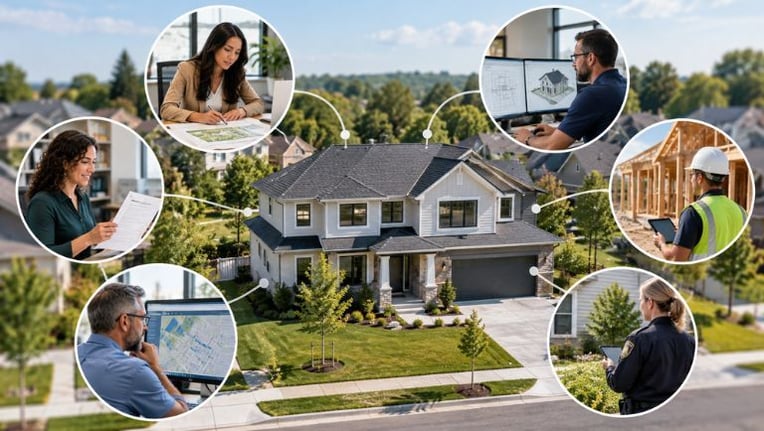
When community development information is organized around the property, staff gain context. A planner can see relevant historical activity; a building official can understand planning decisions; an enforcement officer can see previous permits or complaints; and an inspector can access prior results.
With connected permitting and licensing software, property data management can help make the property a connecting link between departments.
A property's history can include many important details, including:
- Planning applications
- Land use approvals
- Building permits
- Inspections
- Licenses
- Code cases
- Documents
- Correspondence
- Conditions
- Decisions
The shared history can still be limited as needed, such as by assigning roles and permissions that grant access to certain details but not everything.
Connecting actions and departmental decisions to a property's history immediately benefits municipal staff, ensuring everyone works from the same up-to-date, accurate information as things change.
How Every Handoff Can Be an Opportunity for Delay
When one department finishes its work and another begins, manual handoffs can create friction, missed details, and delays from disconnected processes.
Manual handoffs often involve things like sending emails, forwarding attachments, updating spreadsheets, and re-creating data. Manually notifying another department and repeatedly asking whether a review is complete slows work and only adds to the problem.
Connected community development software can support:
- Shared status visibility
- Digital circulation
- Assigned reviews
- Centralized documents
- Automatic notifications
- Linked applications
- Consistent property records
The goal is to make transitions between departments easier to manage and reduce manual steps to get information from one place to another.
One clear example is modern planning and zoning software, which can help teams circulate applications to other agencies and departments, coordinate reviews, and keep comments and responses organized without relying on disconnected email chains.
Why Residents Don't Think in Departments
Residents and applicants don't care which municipal department owns a particular step. They only want to know what they need to submit, whether staff received it, what happens next, and when they can proceed.
Disconnected systems all too often lead to confusion. If an applicant needs to use multiple portals, respond to repeated requests for information, sort through inconsistent statuses, duplicate documents, and keep up with communication from multiple sources, they'll be frustrated, unsure what to do, and unhappy with the overall process.
Connecting community development with modern software creates a more coherent experience for staff and residents alike, even if several departments are involved behind the scenes.
Features like guided application experiences and AI-powered application assistants within building permitting software can also clarify requirements from the start, helping applicants understand exactly what they need to prove.
Why Better Collaboration Doesn't Mean Every Department Works the Same Way
Moving permitting, licensing, and all community development departments to one platform might seem like it'll require everyone to use generic workflows. The truth is, the right software still lets departments work the way they need with configurable processes, while giving everyone shared information, relevant history, and easier access to documents and communication.
Modern software should let planning function like planning, building operate like building, and code enforcement act as code enforcement.
Connected doesn't have to mean identical. Choosing a shared platform that brings departments together while still allowing configuration and unique workflows can help everyone work the way they need to.
Why Information Should Outlast the Employee Who Created It
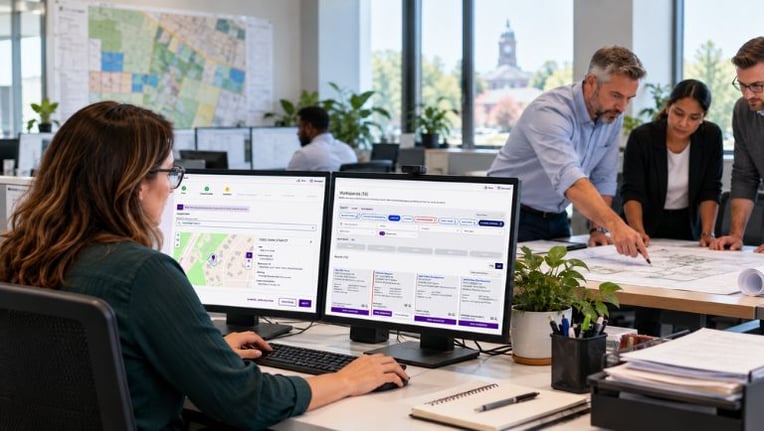
When records live in individual inboxes, personal spreadsheets, paper files, and disconnected systems, a municipality will depend too heavily on staff memory. Connected records let future staff easily understand what happened, why, who was involved, what documents supported it, and what decisions were made, even after staff retire.
Another benefit of departmental connection is a shared platform in modern municipal software.
Connected records support:
- Onboarding
- Cross-training
- Continuity
- Staff turnover
- Long-term property history
Instead of scrambling to find a detail years after someone leaves the team, staff can easily access the information they need to do their work.
How Better Connections Create Better Municipal Reporting
If a building department reports from one system and planning uses another, leadership may struggle to understand their community's overall development activity. Connected data improves visibility into application volume, project activity, review workloads, inspections, cross-department processes, and overall trends.
Departmental reporting will always be an important part of the job, but executive leadership needs cross-functional insight to understand what's happening, what's coming soon, and what to do.
With connected community development software, community leaders can easily find what they need as they make decisions that will affect their municipalities today and tomorrow.
What Should Community Development Software Buyers Look For?
If your municipality is considering its options for better permitting, licensing, and community development software, don't just ask how many modules a vendor offers.
Instead, ask how these pieces connect into one unified platform that brings departments together, improves collaboration, and simplifies processes across the entire community development process.
Ask vendors to demonstrate these connections, and see how they can answer specific questions like:
- Do community development departments share the same property records?
- Can related applications be connected?
- Can reviewers access relevant information without switching systems?
- Are documents centralized?
- Are roles and permissions configurable?
- Can each department maintain its own workflows?
- Does reporting work across the platform?
- Can planning, permitting, inspections, licensing, and enforcement share appropriate information?
FAQs About Connected Community Development Software
Does connected community development software need to replace every existing municipal system?
Not necessarily. Municipalities may still rely on specialized tools for GIS, document review, financial processes, or other functions. The key question is whether the software can integrate with those systems and make relevant information accessible without creating unnecessary duplicate work.
How should municipalities prepare their existing data before switching software?
Start by identifying important records, reviewing data quality, and determining which information needs to be migrated. Consistent property identifiers, accurate addresses, and clear record ownership can help make the transition more manageable.
Can municipalities modernize community development software in phases?
Yes. Municipalities can prioritize departments or workflows based on their immediate needs, staffing capacity, and available resources. When evaluating software, consider whether you can add capabilities later without creating new information silos.
How can municipalities protect sensitive information when departments share software?
Look for role-based permissions, strong access controls, audit capabilities, and clear data-security practices. Sharing relevant information across departments shouldn't mean giving every employee unrestricted access to every record.
What should municipalities measure after implementing connected software?
Useful measures include application processing times, duplicate data entry, manual handoffs, staff time spent finding information, and applicant follow-up requests. Tracking these indicators can help municipalities determine whether modernization is improving everyday work.
Modernize the Entire Process, Not Just the Department
Moving building, planning, and inspections online helps, but the greatest operational value comes when modern processes connect with one another.
Community development is, by its very nature, cross-functional. The technology supporting it should reflect that reality.
See how Cloudpermit helps local governments connect community development processes and property information across departments by booking a demo with us today.